Integrations
Send issue events to your webhook
Get a signed POST to your own URL when an issue is created, updated, closed or commented on, and verify the X-Glitchgrab-Signature
Steps checked September 12, 2026
A webhook sends a POST to your own server whenever something happens to an issue Glitchgrab filed — so you can post to Slack, update your own tracker, or notify a customer when their bug is fixed.
Before you start
- You are the org owner.
- An HTTPS endpoint on your server that accepts JSON POSTs.
1. Add a webhook
- Open Settings in the left sidebar and find Webhooks.
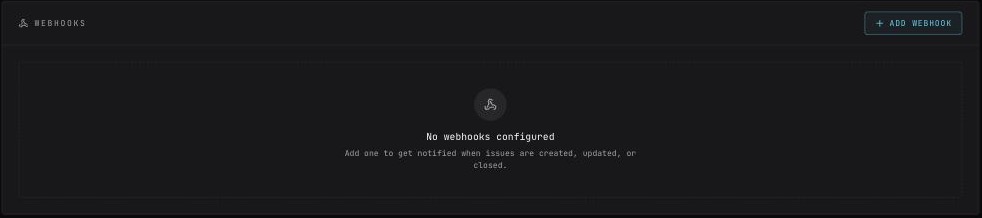
- Press Add Webhook.
- Webhook URL — your HTTPS endpoint, e.g.
https://example.com/webhooks/glitchgrab. - Events — tick what should trigger a POST:
- Issue Created
- Issue Updated
- Issue Closed
- Developer Commented on GitHub
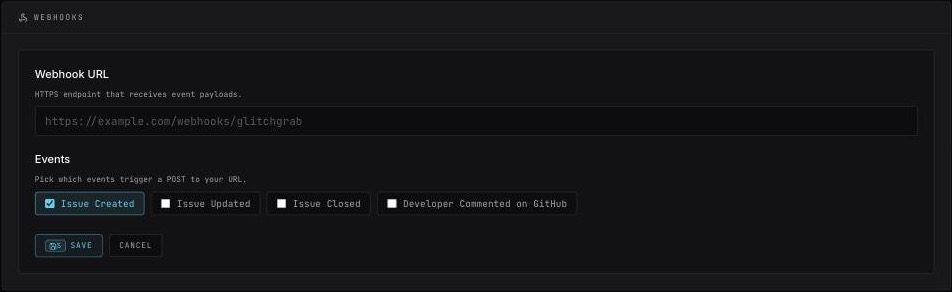
- Press Save. You will see Webhook created.
- The Webhook Secret — copy now, won't be shown again appears. Copy it into your server's environment. You need it to check that requests really come from Glitchgrab.
2. What you receive
Every delivery is a POST with Content-Type: application/json and this shape:
{
  "event": "issue.created",
  "timestamp": "2026-09-12T09:30:00.000Z",
  "data": { }
}
| Event | Sent when | Fields in data |
|---|---|---|
issue.created | Glitchgrab opens a GitHub issue from a report | issueUrl, issueNumber, labels, severity, repo |
issue.updated | the issue changes on GitHub, including being reopened | issueUrl, title, action (e.g. reopened), glitchgrabIssueId |
issue.closed | the issue is closed on GitHub | issueUrl, title, glitchgrabIssueId |
issue.commented | a developer comments on the issue on GitHub | issueUrl, title, comment (body, author, authorAvatar, createdAt), glitchgrabIssueId |
3. Check the signature
Each request carries X-Glitchgrab-Signature: sha256=<hex> — an HMAC-SHA256 of the raw request body using your webhook secret. Reject anything that does not match.
// Next.js route handler
import { createHmac, timingSafeEqual } from "crypto";

export async function POST(request: Request) {
  const body = await request.text(); // the raw body, before JSON.parse
  const expected =
    "sha256=" + createHmac("sha256", process.env.GLITCHGRAB_WEBHOOK_SECRET!).update(body).digest("hex");
  const received = request.headers.get("x-glitchgrab-signature") ?? "";

  const ok =
    received.length === expected.length &&
    timingSafeEqual(Buffer.from(received), Buffer.from(expected));
  if (!ok) return new Response("bad signature", { status: 401 });

  const { event, data } = JSON.parse(body);
  // ... handle the event
  return new Response("ok");
}
Compute the signature over the body exactly as received. Parsing and re-serialising the JSON first changes the bytes and the check fails.
Delivery rules
- Answer with any
2xxstatus within 10 seconds. - A failed or slow delivery is retried once, then dropped. Glitchgrab does not queue deliveries for later — make your endpoint quick, and do slow work after responding.
- Requests come with
User-Agent: Glitchgrab-Webhook/1.0.
Remove a webhook
Delete it from the list in Webhooks — Webhook deleted. The Danger zone below can remove all webhooks at once.
Messages
- Please enter a webhook URL.
- Select at least one event.
- Failed to delete webhook — try again.